

Health Resources Hub / Cancer / Cancer Screenings and Prevention
The Sun Protection Mistakes That Are Putting Your Skin at Risk Every Single Day
Dermatologist Beth Goldstein, M.D., explains why daily sun protection matters far beyond beach days, what early warning signs of skin cancer actually look like and why sunscreen alone is not enough to keep your skin safe.
Advertisement
Advertisement
By
Lana Pine| Published on June 12, 2026
Fact checked by:
Afton Woodward5 min read
Skin cancer is the most common cancer in the United States, and rates continue to climb even as awareness campaigns have become more widespread and sunscreen sales have never been higher. The problem, according to Beth G. Goldstein, M.D., a dermatologist practicing in North Carolina and a spokesperson for The Skin Cancer Foundation, is not that people don’t know sunscreen exists. It is that most people fundamentally misunderstand when, how and why sun protection matters.
“The issue with sun exposure is it’s cumulative over a lifetime,” Goldstein says. “Even though somebody’s not burning and they don’t think they‘re getting too much sun, it’s actually year-round, and we’re constantly getting exposed, even through windows.”
That last part surprises most people. Standard window glass allows UVA rays (the longer wavelength of ultraviolet light) to pass through freely. UVA is present all year long, penetrates cloud cover and can suppress the skin’s immune system while quietly promoting cancer. The side windows of a car are a particularly overlooked culprit. Goldstein points to a well-documented phenomenon: truckers and long-haul drivers who develop significantly more sun damage on the left side of their face (the side facing the window) than the right.
Sun Protection Is Not Just for Summer
Cloudy days and cold months offer far less protection than most people assume. “Clouds will filter out the sun, but they don’t filter out the rays,” Goldstein explains. “You’re still getting those rays penetrating into your skin.” People tend to stay outside longer on overcast days, believing the risk is lower, and end up with more exposure than they bargained for.
Her recommendation is simple: Treat sun protection the way you treat brushing your teeth: as a daily, non-negotiable habit. That means SPF 30 or higher broad-spectrum sunscreen every day, applied generously. A hat. Sunglasses. Sun-protective clothing with a UPF rating or tightly woven fabric. Seeking shade. Avoiding midday sun between roughly 10 a.m. and 2 p.m., when UV intensity peaks.
On the subject of sunscreen specifically, she is candid about its limitations. “Sunscreen only reduces your risk by 50%,” she notes, a number that surprises many patients who treat SPF as an invisible forcefield. The best sunscreen, she emphasizes, is the one a person will actually use consistently. Mineral-based formulas have improved significantly in texture and feel, and tinted versions can double as moisturizer and light coverage, making daily adherence easier.
What to Actually Look For
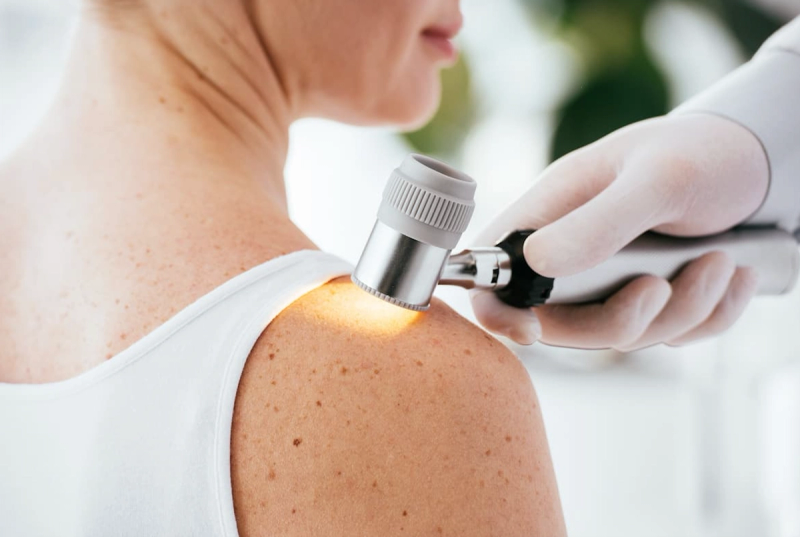
Goldstein has treated tens of thousands of skin cancers over the course of her career, and she describes watching patients get younger and younger as the years have passed. She urges everyone to know their own skin by using a smartphone to photograph the back, legs and hard-to-see areas to establish a personal baseline, then monitoring for change.
For melanoma specifically, she points to the ABCDE rule: asymmetry, irregular borders, color variability, diameter larger than a pencil eraser and evolution or change over time. But she is equally insistent about one thing people get wrong: Melanoma does not have to be dark. “Melanomas can be pink, they can be gray,” she says. “It doesn’t have to just be dark to be bad.”
The more common basal cell and squamous cell cancers often look deceptively ordinary: a pimple that will not go away, a dry patch that does not respond to moisturizer, a bump that just looks a little different from everything else nearby. “If you wait for it to hurt or bleed or bother you, you’re waiting really long,” Goldstein says. “It’s there on your skin for you to see it every day.”
Her recommendation for anyone who wants reliable, accessible information is the Skin Cancer Foundation’s website, a resource she calls “excellent” for patients who have concerns about a spot, have received a diagnosis or want to understand their options.
The bottom line: Wear a hat, wear a shirt, wear sunscreen, wear sunglasses, avoid midday sun and do not wait to get checked.